Umm Faisal lost her family and now lives in a warzone during a pandemic

Umm Faisal has suffered repeated tragedy and trauma since the war in Syria began a decade ago. Both of her sons were killed when their village was bombed. One died from injuries caused by shrapnel, the other was killed while he was working.

The house was completely destroyed and Umm Faisal only survived because she managed to flee to another village in time. From there, she fled to the Aleppo countryside before heading onwards to another village. Umm Faisal describes the grief she felt at this terrible loss.

“My sons were the most precious part of my life. Youssef was 20 years old and Faisal was 35. One of them was married and had 4 children. I grieve for his family. My grandson saw his father dying and fell ill for months due to the shock. He then passed away as a result of this.”

Living in constant fear

Umm Faisal also dealt with severe trauma as a result of her loss and this has triggered health complications, such as asthma.

“A mother’s pain after losing her two children is indescribable, it feels like more than I can bear. When I heard the news, I wanted to take their place.”

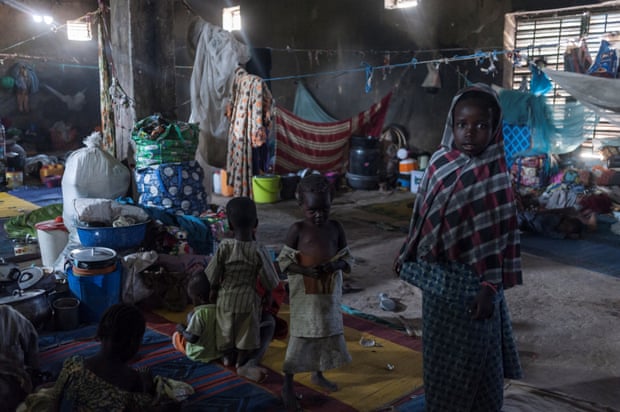
She is now responsible for her grandchildren. Traumatised, the family live in fear of passing planes, the sound triggering deeply painful memories. They have been displaced for five years, and now live in a tent.

Hardships in finding food

Due to extreme poverty, Umm Faisal and her grandchildren rely on aid from humanitarian organisations. She does her best to earn money to provide for her family, running a small vegetable store and using the profits to buy food, but worries what will happen if coronavirus advances still further.

“If it wasn’t for this shop, I wouldn’t be able to provide any food for my grandchildren. I am very worried that the coronavirus pandemic will mean a lockdown will be imposed in this area, which will stop me from being able to sell my vegetables. I pray to God to keep this disease away from us so that I can continue to work.”

Covid-19 has made conditions even more unbearable

The coronavirus pandemic has worsened the already difficult living conditions in the hundreds of camps throughout northern Syria, posing an extremely high risk to people that are living in very close confines, with limited hygiene supplies. Islamic Relief has been distributing essential personal protection equipment, such as masks and hygiene kits to help people to protect themselves from infection.

Umm Faisal received a mask and has been wearing it, but finds it very difficult because of her asthma. She finds life in the camp even more difficult now that there is such a high risk of infection.

“I am scared of the virus because I suffer from severe asthma and a doctor warned me that I am at high risk of developing complications from the virus. I always keep my inhaler by my side, and it is very important to me. When I feel short of breath, I use it immediately and it helps. When I lose it, or if it’s not available, I feel anxious.

I have been trying to protect myself, but it is impossible to socially distance in these camps. Seven people live in each tent, which puts us at high risk.”

Hope for an end to the war and a reunion with family

In addition to masks and hygiene kits, Islamic Relief has provided food parcels and qurbani meat to alleviate.

“The support you give us is an essential part of our lives that we cannot live without. I pray that you will keep providing us with aid.”

After a decade of conflict and suffering, Umm Faisal longs for things to return to the way they once were. Her surviving relatives are living all over the world and she dreams of meeting them once again.

Read more in our report. Help us continue to be a lifeline for people like Umm Faisal who are suffering in this desperate crisis: please donate to our Syria appeal.

A medic on the frontline of Syria’s coronavirus battle speaks out

Dr Ihsan is a cardiologist working in a hospital in northern Syria. Like many hospitals in Syria, there are no facilities for Covid-19 patients at the hospital where he works.

Many medical centres in the area lack the vital equipment, such as x-ray machines, CT scanners, and laboratories needed to treat patients with Covid-19. Dr Ihsan describes the important precautions that his staff take when treating patients at the hospital.

“At the hospital, we are taking precautionary measures and wearing masks and gloves. All patients have their temperature checked before entering the hospital and are asked if they have symptoms of coronavirus. If they are symptomatic, they are sent to the quarantine centre.”

The reality of statistics in Syria

Covid-19 reached northern Syria relatively late, but is now spreading quickly. Dr Ihsan worries that the number of confirmed cases could be higher than official figures show.

“The total number of cases [are] much higher, as not all those with symptoms take a test. Many people are afraid to have a positive test result, and decide to isolate and stay home until they feel better.”

Dealing with the Coronavirus was easier during the summer, as people were able to practice social distancing by spending time outside. However, the freezing Syrian winter makes social distancing much more difficult, and with up to 10 people living in each tent, the virus can spread much faster.

Challenges inside refugee camps

Due to the deep poverty faced by people in the camps, not everyone can afford to buy masks and even with the knowledge of how to practice good hygiene, not everyone has the means to do so. This puts people living in the camps at very high risk of infection, with little means to control an outbreak.

“Due to communal bathrooms, clean water is not available all the time. People are unable to regularly wash their hands, as they do not have water or soap. If someone gets coronavirus, it is impossible for them to quarantine as they are living in a tent with six other people. We pray to Allah for help for these people,” Dr Ihsan tells us.

Life in a crisis zone during the pandemic is taking its toll on doctors like Dr Ihsan.

“We see a lot of sad cases, some of which we are unable to forget. For example, 4 years ago, an air strike happened at the entrance of our hospital. A guard, a nurse, and two others were killed. We were unable to do anything for them.”

The heart-breaking side of being a doctor

He describes a young man of just 24 who came to him. He had no history of medical conditions and was showing only mild symptoms.

“Two days later, his situation got worse. His oxygen saturation level was very low. I sent him to the quarantine centre in the hospital, where he was admitted. His oxygen saturation levels dropped even further and he was given oxygen. They then did a scan, which showed a worrying picture. I hope he recovers soon.”

Dr Ihsan also worries about the impact of winter on those who already suffer from health conditions.

“For those with chronic illnesses, winter is very dangerous, as getting the flu can worsen their condition. They would require quality medical care. However, Covid-19 even affects healthy people. This means that the situation is even more difficult for those dealing with malnutrition, chronic illnesses, heart disease, or with issues in blood pressure or blood sugar.”

Hopes for the future

Looking to the future, Dr Ihsan feels uncertain.

“Thinking about 10 years into the future feels impossible. At the moment, we can barely think about the next month as we don’t know what is going to happen. Many people are dreaming about going back to their homes.

“We know that more than 1.5 million were displaced in the last few months. So, we dream about peace in this area, we dream about all displaced people being able to go home, leaving their tents and their miserable situation.”

For a population that has lived through a decade of crisis, Covid-19 is just another tragic reality to deal with. Although people are very fearful of becoming ill, Dr Ihsan reports that, to many, the virus is just another crisis, that pales in comparison to the horrors that they have already lived through.

“People here are not very scared about Covid-19, because they have already been through so much. They have dealt with airstrikes, displacement, miserable living conditions and losing loved ones. So, many consider Covid-19 akin to a mild infection, and nothing compared to the injuries caused by air strikes, psychological trauma or the poverty they have been living in.”

Islamic Relief is at the forefront of the response to the Covid-19 outbreak in Syria. As part of efforts to reduce the spread of coronavirus, we gave 84 health facilities personal protective equipment (PPE) including masks, gloves, and medical gowns, as well as no-contact thermometers, hand disinfectant gels, disinfectant sprays and other sterilisation solutions. We ran awareness-raising campaigns in health facilities, which we also supported to establish quarantine areas.

Read more in our report. Help us continue to be a lifeline for those still suffering after a decade of crisis: please donate to our Syria appeal.

A decade of crisis in Syria leaves millions of people suffering like never before

This week marks 10 desperate years since the beginning of the devastating crisis in Syria. Over 11.1 million people in Syria, and millions of others who have fled the country, need humanitarian assistance.

Since the crisis began in March 2011, the Syrian people have faced unthinkable levels of hardship and loss. Recurrent rounds of violence have inflicted intense suffering and forced people to flee repeatedly in search of safety. They have experienced deepening poverty and inability to access basic resources and services.

Do not forget Syria in 2021

The humanitarian situation continues to deteriorate in the northwest, where millions of people uprooted from their homes are struggling to survive. Suffering is widespread amid shortages of food, medicine and fuel in addition to the devastating impact of the Covid-19 pandemic and the collapsing economy.

It is feared that the number of people in Syria will rise to a staggering 13 million this year.

“As the crisis enters a second decade, the Syrian people must not be forgotten. There is still time to act to prevent yet further catastrophe. In 2021, the world must no longer ignore the plight of the Syrian people”, says Tufail Hussain, interim CEO of Islamic Relief Worldwide.

“We pray to God for relief and to one day return to our homes safely.”

Umm Ismail and her children fled their village, in Jabal Al-Akrad, barefoot in the middle of the night when violence broke out five years ago.

Umm Ismail recalls: “We were sleeping when the bombing started, but woke up terrified. Children and women were screaming everywhere. We were very afraid.”

They took refuge in a neighbouring village, but soon after bombing began there too and they had to flee again. Eventually they reached the Ali camp on the Turkish-Syria border. Two of her children are very unwell.

Umm Ismail explains, “If my son is without medicine, he cannot move. We rely on charity to provide his medicines, as they are not available in hospitals in northern Syria.” Umm Ismail has also been ill over the last few years, especially in winter and amidst torrential rain and flooding.

“Before the crisis we ate delicious food. We used to raise livestock, live off the produce, sell the excess and earn a good livelihood. But that is in the past. Now, our house has been demolished by the bombs, our lands are burned, our livelihoods ruined and everything is lost. We can barely afford the price of bread.”

Umm Ismail is among over 770,000 people in Syria to whom Islamic Relief provided food and freshly baked bread last year.

Umm Ismail says: “Thanks to God, Islamic Relief provides us with food and hygiene baskets. The basket keeps us going for about a month. We pray to God for relief and to one day return to our homes safely.”

Helping refugee families become resilient

Mother-of-four Hoda is one of 6.2 million people to have fled Syria since the start of the crisis. She endured dire living conditions in Syria before seeking refuge in Hatay, Turkey. However, once in Turkey, finding work was almost impossible.

“I could not find a job here because this city is small and has a large number of Syrians. I cannot leave my children at home and be away from them for a long time”, says Hoda.

Islamic Relief worked with Hoda to help her earn a reliable living. She now works at an Islamic Relief greenhouse, where she has been given crops to tend and sell for profit.

Hoda’s family are just one of 450 in the area to receive help through agriculture, beekeeping and vocational development support projects provided by Islamic Relief. Many of these families have been given plots of land for them to plant tomatoes, strawberries and sustain beehives, so that they can subsequently sell the produce.

Working harder than ever to end the crisis in Syria

Since the crisis began, Islamic Relief has invested £350 million in delivering life-saving humanitarian programming. Last year alone, we were a lifeline for around 2.5 million* people.

We provided food, emergency healthcare, and specialist medical services such as blood banks, dialysis and heart surgery. Islamic Relief ensured vulnerable people had access to shelter and survival items including blankets and plastic sheeting. We offered life-changing livelihoods support, education interventions, and a safety net for hundreds of vulnerable orphaned children. In addition we increased access to water, sanitation and hygiene, and provided solar energy.

However, countless people in Syria continue to suffer as we mark the grim milestone of a decade of crisis. They need our help now, as much as they ever did. Over and over again, they tell us they long for peace.

Islamic Relief calls again on the international community to increase support for desperately needed humanitarian efforts and apply pressure on all parties to immediately de-escalate the violence. And crucially, we call for action to secure a lasting solution to this dreadful crisis. Peacebuilding must focus on building viable livelihoods for the poorest families as well as supporting communities to become more resilient. Only then can the people of Syria live, work, and raise children in safety and security.

Help us continue to be a lifeline for those still suffering: please donate to our Syria appeal.

* Islamic Relief aims to maximise the positive impact we make by integrating projects wherever possible. In this figure, some people who have benefited from two projects have been counted twice, and some who have benefited from three projects have been counted three times.

Raising children in crisis zone: a Syrian grandfather’s fight to keep his grandchildren safe

Mohamed, his two daughters and their children have rarely been far from danger in northern Syria, which is now marking a decade of crisis and suffering.

Displaced multiple times, Mohamed currently lives in a camp in northern Syria with his five grandchildren, who lost their fathers during an airstrike.

“Our homes were completely destroyed and the bombs killed many women and children. We fled under a barrage of bombing, thankfully escaping with our lives,” Mohamed remembers.

“It is almost impossible to buy food.”

Neither of Mohamed’s daughters has been able to work, and with the collapse of the Syrian currency and the spiralling cost of resources, it is almost impossible to buy food. The family relies on food they are given, but it is rarely enough to feed them all.

“I find it very difficult to buy enough food because it is so expensive. The children often ask me for sweets and it makes me so sad to know that I cannot buy any for them.” He tells us that they have been eating two meals a day and going to bed hungry.

“Before the crisis, we ate three meals a day, as well as fruit, sweets, and snacks. Food is essential, and when we are able to get enough food, we will feel safe.”

Harsh winter makes life even more difficult

The harsh Syrian winter has made life harder for Mohamed and his family. Their tent got torn and water seeps through. The family does what they can to stay warm, often walking long hours to the top of the mountains to collect firewood.

Mohamed suffers with stomach issues, for which he needs surgery. This is something that he simply cannot afford but that he longs for as the pain keeps him up at night and he worries who will take care of his family if he isn’t able to work. “I am so afraid that I will die and there will be nobody to take care of them and provide for them.”

He and his family also face the growing threat of coronavirus, which is now reaching the camps in northern Syria, leaving poverty-stricken families struggling to protect themselves against the deadly virus.

“We fear infection. We heard that the Coronavirus is spreading in the neighbouring camps. I worry about the children. I have bought protective masks for them to keep safe. I’m also scared because of the disease I’m suffering from. I am afraid of leaving the tent or going to the store or anywhere else.”

The virus has not yet reached Mohamed’s camp, but they are already taking precautions and his grandchildren have stopped attending school. “I advise them on how to take protective measures against infection and they now wash their hands regularly with soap.”

He has turned to using some of the money needed for food to buy masks for the children.

Easing the suffering of people who have suffered so much

Islamic Relief has provided Mohamed and his family with food parcels, hygiene kits, and qurbani meat to ease some of their hardship. Now they are able to eat wholesome food and better protect themselves from infection and illness.

“The baskets that you provide contribute to the alleviation of this suffering and we are very relieved when we receive them. It makes me feel safe because I know I can provide food for my grandchildren. We cook meals using the food they contain. I hope we will continue to receive this type of aid, because it saves our lives.”

Still, he tells us that every day feels like a year due to the poverty, tragedy, and daily struggles that they face. The grandfather wants nothing more than an end to the suffering in Syria. He reflects that, 10 years on from the start of the crisis, it feels as though 50 years has passed.

Deep inside Syria, Islamic Relief has been providing food and freshly baked bread, reaching over 770,000 people in 2020 alone. With your help, we will continue to be a lifeline for those still suffering after a decade of crisis: please donate to our Syria appeal.

“Women and girls are capable of extraordinary things”

This International Women’s Day 2021, we’re putting the spotlight on the exceptional women in our organisation. These women are driving real change for Islamic Relief and the communities that we serve. Here we hear from Arwa Kawan, a community fundraising officer for Islamic Relief UK.

I am currently the only female community fundraiser for Islamic Relief UK, and the first Arab woman in my role too. Working at Islamic Relief, I have been very lucky, as I have been always treated with respect and fairness and was allowed to set my personal boundaries from the start. I never feel that being the only woman in my line of work is an issue, though I’m eager to see more women getting involved.

However, when I’m working in the community and meet people with my male colleagues, I find that people talk to the men rather than me. Even after I introduce myself some ask to speak to “whoever is in charge”. I’ve even been at events with male volunteers, in which people directed their questions to the male volunteers rather than me, the person in charge.

It annoyed me. I felt that no matter how far I got in my career people would still overlook me merely because I was a woman. I then choose to be more assertive. Now when people do that I tell them to speak directly to me, and that they shouldn’t treat me differently because I’m a woman. I am proud to be a lot stronger now, and able to navigate these situations and challenge harmful behaviours.

Challenging stereotypes and breaking down barriers

Women have always been forced to conform to social and cultural status quos, so we need to challenge these ideas of what a woman can and cannot do, and to take up spaces from which we were previously excluded.

I worry that people may misunderstand this as taking peoples’ jobs, or forcing women into spotlights they don’t want to be in. This is not the case: it’s about breaking stereotypes of what a woman should do in the workplace, challenging toxic cultural and societal ideas that minimise the importance of womanhood.

I’ve always challenged any ideas that men and women aren’t equal or shouldn’t be offered the same opportunities. My religion has taught me that I am important, and there is no one that can tell me otherwise. Throughout my life I was forced to challenge people. I was told by my university lecturers that my dyslexia would deter me from completing my English degree. They underestimated me.  I not only finished, but I excelled and I was able to finalise my Master’s degree.

Growing up inspired by strong women

I’m inspired by the example of Khadjiah RA, who is known for being trustworthy and loyal. She was the first to become Muslim and was the mother of the Believers. Also – and she would probably roll her eyes at me for saying this – my mother has shaped me to be who I am. She taught me to be compassionate and grateful. She taught me to have dignity and respect for myself, and to navigate difficult situations. My mother was an accountant before she had me, and believes that women should be self-sufficient. She sacrificed a lot so I could have opportunities, and that is why she is the person in my life that inspires me the most.


In addition, I am part of a community that champions women working in roles previously reserved for men – though the expectation is still that women are married with children by a certain age. I have been taught by my mother that none of that is important. That as long you’re a good person and faithful to God, you are more than enough.

As I grew up the community expected that I behave in a restrained way, to be careful of how I speak around men, and to not be aggressive with my ideas and opinions. Worries about what people would think of me kept me quiet. But my mother pushed me to speak my mind, even when I felt uncomfortable. Now I always speak up when I see wrongs being done.  I don’t hold back anymore, in my work and my life.

Enabling women to make a difference

Working as a fundraiser is a blessing as I’m as close to donors and work within the heart of the community. I am raising funds for women around the world so they can have access to food aid, empowerment and livelihood projects.

It also means I’m able to directly engage with women in the community who want to make a difference. Many times people want to help but they feel like they can’t make an impact or create change – especially women and girls. As a woman I can work closely with them, in mosques and community centres and girls’ schools. I encourage them to make a difference, to let their voices be heard and to take action. I encourage them to consider a career in community fundraising – we need more females on the frontlines and in positions of change.

I’d advise women and girls interested in pursuing a career in community fundraising to set boundaries, speak out when something doesn’t feel right and always speak your mind. Stop thinking your voice isn’t important. It took me much longer than it would have liked to come out of my shell as a fundraiser, but every time I’ve spoken up, my contribution made a difference.

Never let self-doubt make you pass up a good opportunity. Never feel like you are not worthy. Do not allow men to push you to the side. And when you achieve your dreams, do all you can to create more opportunities for women.

“I admire women who say ‘yes’ when society expects them to say ‘no’”

This International Women’s Day, we are celebrating Islamic Relief’s exceptional women. We are proud of their achievements, as individuals and as colleagues.  Here we hear from Mersiha Karic, a social worker who has worked with Islamic Relief in Bosnia and Herzegovina for 20 years.

The theme of this International Women’s Day, #ChooseToChallenge, is an important one for me, since I have always faced an environment of prejudice, stemming from tradional patriachal norms. The first time I challenged the status quo was when I started working for Islamic Relief – something that was unusual for women in Bosnia and Herzegovina 20 years ago.

My job as a social worker is all about commitment and responsibility. I work with vulnerable communities and women who need positive role-models in their life. My efforts have a direct impact on the people I work with: the mothers, the children, the boys and the men. I spend time educating them and finding creative ways to talk to them about topics like gender-based violence, education, justice and life skills.

Challenging traditional roles for women

In my country, the position of women in today’s society is challenging and stressful. Women’s roles are still very traditional and we haven’t adapted to more modern attitudes. When it comes to women in business and politics, we are only there symbolically. When it comes to regular jobs, women fill the positions traditionally assigned to them – such as nursing, art and education. Business segregation and the division of labour into men’s and women’s affairs is very much present in our society. Every day we meet women hairdressers, teachers, but rarely do we meet female miners or computer programmers.

The advice I would give to young women is to be aware of their value, but to also seize the opportunities that come their way, and most importantly to believe in themselves and to have self-confidence. I once read a quote somewhere that resonated with me: “Self-confidence means believing in yourself, but we cannot trust a person who will only do what is easy and what does not hurt.”

I admire every woman who stepped out of her comfort zone, the ones that challenge by saying ‘yes’ when they are expected to say ‘no’ and vice versa. I admire the women who do the impossible, although others doubt them. Those are the women, and the lessons they teach, that I admire the most.

The fight for women’s rights

Women’s rights laws look great on paper, but there is more needed in the fight for women’s rights. One of the biggest problems is that we neglect raising awareness in smaller towns and villages, though they deserve to be part of this conversation.

The Prophet Muhammad (SAW) taught us primarily by his own example, so I believe it is necessary for men to set an example by promoting gender equality. I believe that no one should be left behind, and if we all come together and speak so loudly that even the people in the back can hear, we can win equality for women, wherever they live.