Displaced from Gaza and now living in another country in the Middle East, Islamic Relief’s Mariam* continues working tirelessly to support vulnerable people back home in Gaza, including her colleagues, who are facing incredible hardship. This World Humanitarian Day, we pay tribute to humanitarian workers doing all they can to support the people of Gaza.
Mariam carries the weight of 2 wars.
By day, she documents Gaza’s collapse in stark statistics: 90% of the population displaced, often multiple times; 71,000 children under 5 years old acutely malnourished, and critically, over 100 confirmed deaths from malnutrition so far – deaths that include children under 5 and no hospitals in North Gaza functioning as they either have been destroyed or forced to cease operations.
By night, she counts personal losses: How many days since she last heard from her brother in northern Gaza, how long it’s been since her husband – also still in Gaza – last ate, how many nights she’s spent lying awake worrying about her sister and family.
Since Mariam left Gaza 16 months ago, 2 phones are her tether to home. While a work device blinks with constant reports from colleagues, her personal phone holds precious voice notes from her husband.
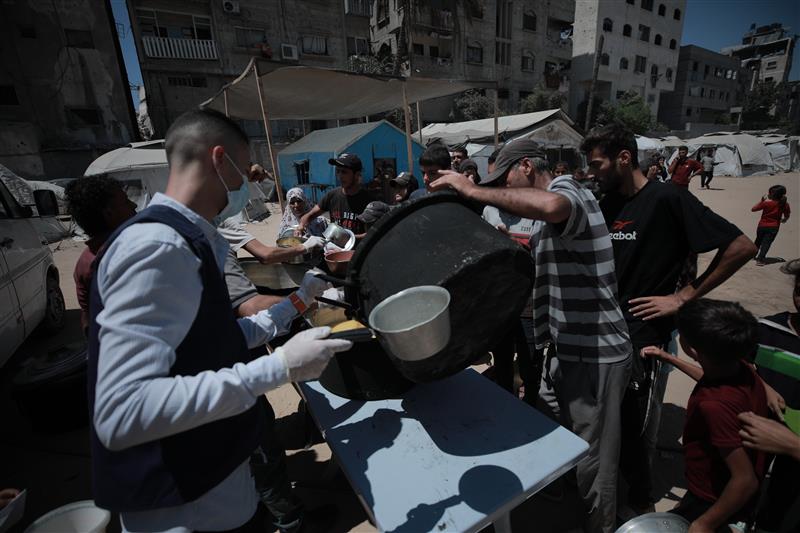
“This is my reality now, supporting and monitoring food distributions while wondering if my husband ate today,” says Mariam, who has been working for Islamic Relief for 16 years.
“I review reports of infants starving to death in northern Gaza, then make breakfast for my own children.”
When the helpers need help
Now displaced and still supporting Islamic Relief’s response remotely, Mariam embodies both the extraordinary strength and impossible choices facing Palestinian aid workers.
“My colleagues who are still in Gaza work under bombs with no safe place to sleep. All of them have been displaced – most more than once – yet they continue their work. I sit here with a roof and running water, supporting their efforts remotely. But we hold our breath every day until we know they are safe. We try to take as much workload off them as possible, even though we are under pressure ourselves, because we know they are working under unimaginable conditions. They are exhausted, traumatised, yet still show up every single day. How can I not do the same?”
Over 483 aid workers, including 326 UN staff, have been killed in Gaza since October 2023. Mariam recounts an attack on a UN school sheltering displaced families – one of numerous such incidents targeting civilian shelters this year. In July this year, 3 staff members from Human Appeal were killed while doing their job.
“That could have easily been one of us,” Mariam says. “I was working inside Gaza under the same risks, moving between distribution points and shelters, fully aware that any moment could be my last. The only difference between me and those we lost is chance.
“This isn’t collateral damage, it is targeted,” Mariam adds. Among those killed were colleagues she once worked closely with, people she considered friends. One was Aseel Khudr, a nurse who lost her life while treating patients at Al-Sahaba Medical Centre. Another was a healthcare worker at an organisation Islamic Relief partners with, killed while fulfilling their humanitarian duty.
The statistics Mariam monitors tell the story of Gaza’s collapse as a result of Israel’s systematic and deliberate destruction of everything people need for survival. Even after Israel allowed aid into Gaza in July, only 40% of UN-led convoys were completed. The rest were either denied or impeded by Israeli forces or suspended due to insecurity. 2 million people – almost everyone in Gaza – face acute food insecurity. People have been gunned down and bombed while trying to get food, with over 1,239 civilians killed and more than 8,152 wounded while seeking humanitarian assistance since May 2025.
But numbers alone can’t capture what it means to deliver aid when the rules of war are being completely ignored with impunity.
The women keeping Gaza alive
What sustains Mariam are the women of Gaza – the doctors performing surgeries by the light of their phones, the teachers holding lessons in bombed-out buildings, the mothers inventing ways to stretch a cup of flour into 3 meals. She describes colleagues who spend mornings documenting war crimes and afternoons searching for firewood.
“Before this war, we had washing machines, universities, and cinemas,” Mariam says. “Now, women wash clothes in sewage-contaminated water and teach math in rubble.”
Mariam pushes back against the stereotype that Palestinian women are somehow ‘used to’ hardship – that’s simply not true. “People looking from the outside might think we had lived like this all our lives, but in reality, [since October 2023] we have had to reinvent everything just to survive.”
Mariam shares the story of Fatema, a graduate of Islamic Relief’s Orphan Sponsorship Programme, who is now an aid worker herself.
“I first met her when she was 12, when I was starting my own career. She was bright, writing poetry despite losing both parents,” Mariam says. “Years later, she joined our team.”
Fatema’s husband and son were killed in an airstrike while she was at work.
“When I saw her on TV crying, holding the toy she just bought for her son, my heart broke into pieces. Later, I learned she went back to work, with even more determination, because somehow, she didn’t let it break her. For me, she is the true meaning of strength and dignity in the middle of so much pain. Whenever I feel like giving in to exhaustion or despair, I think of her, and she reminds me why we keep going.
What acting for humanity really requires
For Mariam, this World Humanitarian Day’s slogan, #ActForHumanity, isn’t just a hashtag, but a daily practice with concrete demands:
First, stop the weapons fuelling this catastrophe. “No more ‘deep concern’ statements while bombs keep falling. We need enforceable arms embargoes now.”
Second, pressure Israel to end its blockade and guarantee unfettered aid access. “Every day our convoys are blocked means more children like Fatema’s son are buried in mass graves.”
Right now, people are starving, drinking polluted water, and dying, not just from bombs but from hunger and preventable diseases. No hashtag can replace trucks filled with food, medicine, and fuel. Nor can it rebuild the homes, schools, and hospitals, reduced to rubble.
Mariam adds that “acting for humanity also means seeing us as people, not numbers. For Gaza, it means listening to communities, respecting their dignity, and ensuring aid reaches the most vulnerable, in a fair and dignified way. It also means holding those who violate humanitarian law accountable, because silence in the face of this suffering is complicity.”
And finally, she says, remember the displaced. “Whether in neighbouring countries or elsewhere, many Palestinians outside of Gaza are living without residency rights, school access, and healthcare. Survival shouldn’t be the endpoint of dignity.” And for those forced to flee Gaza, the right to return must never be forgotten.
On World Humanitarian Day, Mariam hopes her message cuts through the noise: because true solidarity means showing up, not just when it is trending, but when it is terrifying and the world looks away.
Islamic Relief continues delivering lifesaving aid in Gaza against almost-impossible odds. Support our Palestine Appeal today.
*Name has been changed to protect confidentiality