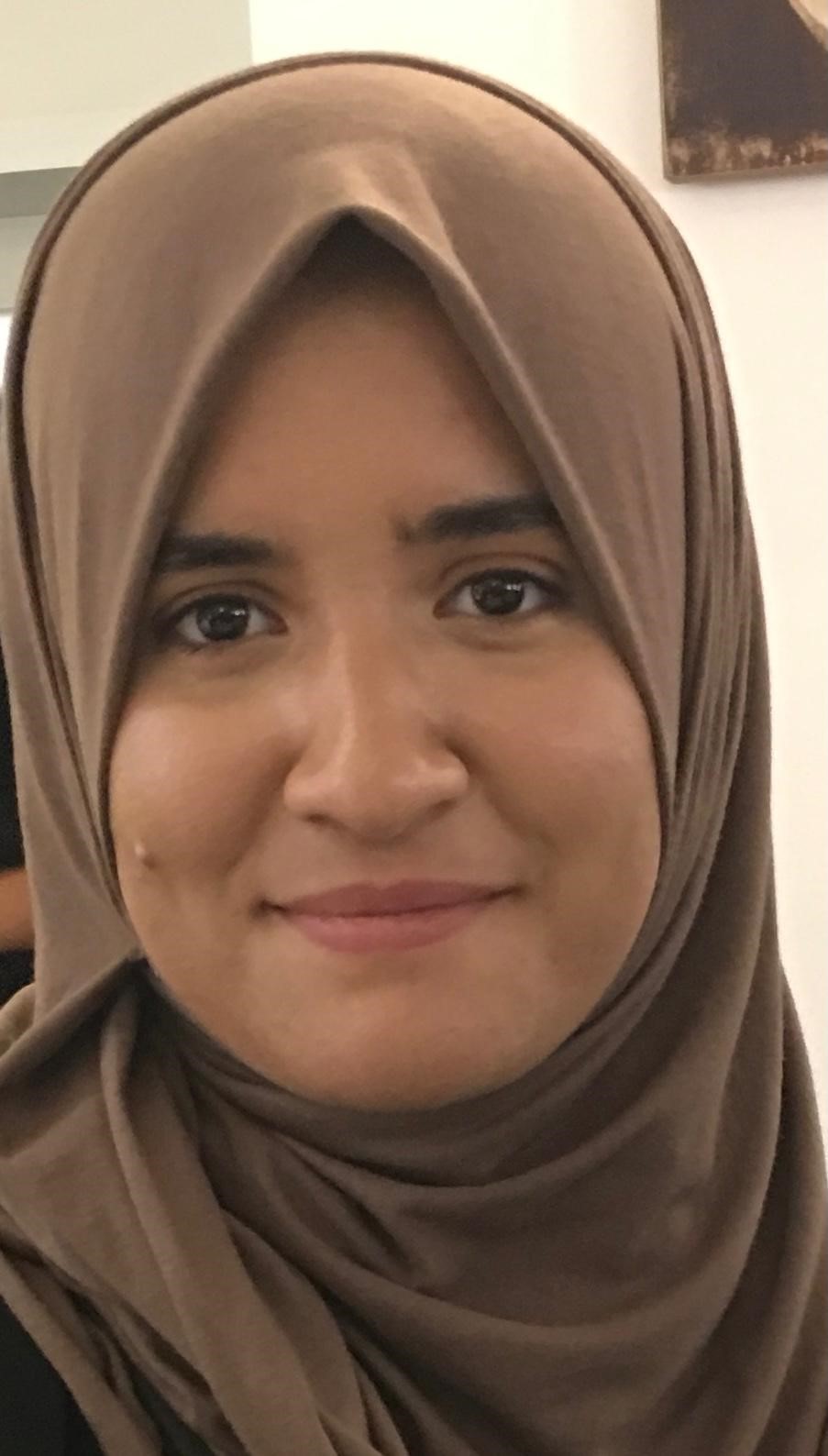
Haya: My disability won’t hold me back

Wheelchairs, crutches or other visual indicators of disabilities are often the first thing to come to mind when we talk about disability. But what about people with disabilities that are not so immediately apparent? The challenge of living with ‘invisible disabilities’ is something with which Haya, 19, is very familiar.

Haya, who lives with her family in Gaza, was diagnosed as being deaf-mute at two-years old. Growing up she experienced many challenges, especially when it came to communicating with people.

“When most people first approach me they think I am like them,” says Haya. ”There is always an awkward pause when I don’t talk back”.

As a child, she did her very best to be like other children but over the years she has grown in confidence.

“Unlike others, my disability is not on display, but I also don’t hide it. It sounds corny, but I don’t want to pretend. This is me, I have a disability, deal with it.”

Passionate about education, she was disappointed when she learned that she couldn’t pursue a degree in Press and Media at her local university.

“I have always loved photography, and when I was told I would struggle due to my disability, it made me more determined to prove everyone wrong. I eventually enrolled in a specialist photography training course at another university, and I am proud that I didn’t let the naysayers hold me back,” adds Haya.

Today Haya is an inspiration to many girls in Gaza and is now doing a traineeship with Islamic Relief Palestine.

“Islamic Relief has granted me a six-month training opportunity in their media department. I was so happy when I first heard the news. But then I got a bit afraid because I knew that no deaf-mute person had worked with Islamic Relief Palestine before. But the opportunity to further develop my photography skills outweighed my fears, and I decided to teach my colleagues sign language to break our communication barriers”.

Haya continues to advocate for more inclusion and visibility around disabilities. Based on her own experiences, Haya knows that when girls are educated, they become more aware of their rights. So she is pushing for more opportunities for people with disabilities and women and girls, as she strongly believes this benefits society as a whole.

“Training at Islamic Relief has enhanced my self-confidence and I am now able to say to the world that people with disabilities are no different from anyone else, we have purpose and are able to contribute at work. My experience in the Islamic Relief media department is evidence of that.”

Islamic Relief hopes that offering trainee programs to people like Haya shows the importance of inclusion and help change preconceptions about people with disabilities.

For women with disabilities this is even more important, as they face double discrimination. They are seen differently because of their disability and because of their womanhood. Islamic Relief is working incredibly hard to challenge that.

“I can’t fight with words as my voice does not exist, but my spirit has always been stronger than my disability. I want to show girls that we should never be limited by anything, whether it is physical or societal,” says Haya.

The United Nations had declared the 3rd of December to be the International Day of Persons with Disabilities, an annual celebration of people with disabilities.

Through advocacy, campaigns and community outreach Islamic Relief changes attitudes and ensures people with disabilities can access inclusive, quality education, work opportunities and care.

Would you like to support our work, so that we can make more dreams like Haya’s possible? Support now.

“I help survivors of abuse like me to see a different way to live”

Nermina, who lives in Gracanica in Bosnia and Herzegovina, experienced many years of domestic abuse. Here the 43-year-old reveals how Islamic Relief has helped her and why she speaks out to empower others.

My husband was an alcoholic and I had a difficult marriage for the 15 years I was married to him.  We all suffered. The memories I had of him all involved him coming home drunk and hitting me and my children.

His presence in the house in the house frightened us. His threats and physical abuse became more frequent over time, especially after he lost his job due to his alcohol abuse.

I struggled a lot as a mother and a wife. I became the main breadwinner. I had to protect my children from my husband – he used to hit me in front of them whenever I objected to his drinking or his demands for my oldest son to walk for miles so he could feed his addiction.

Sometimes we would slip away from home very early and take shelter with my parents until he calmed down. He had extremely volatile emotions and I was afraid of what he might do to me and my children.

But I learned to cope – I had to. At the beginning I didn’t have the strength to leave. I was young when I married him, and since we were going through a war in Bosnia I gave him many chances to change. I confronted my husband after he beat me severely when I was pregnant with my oldest child. No one intervened and I felt so alone.

Still I always threw myself into fights with him to protect my children. I just didn’t want to see him pound their heads against the wall or break their bones.

My husband eventually died, but he left a long lasting effect on my family. My eldest son in particular has psychological issues that stem from living with his father. I have tried to push him to go see someone, but I haven’t been successful. My only desire is to see my children happy and successful.

We give ourselves a voice

I have gained hope by talking to other women who suffer from domestic violence. Many of my friends and neighbours have also suffered a lot from gender-based violence. And that’s why Islamic Relief is so important to me, because they empower women through various projects so that they can escape from abusive situations. I have received Islamic Relief support through working on greenhouse projects and receiving sponsorship for my young son.

But most importantly, I have been able to get mental health support through Islamic Relief’s psychosocial programme. I have never gone to therapy before and now I speak about what I have been through and even though I get emotional through Islamic Relief I now realise that I am not alone. It’s important to stand up for yourself and not normalise violence, especially given the current climate the world is in at the moment.

I keep hoping that people will open their eyes and see that we can live in a different way. When you talk with people, you realise so many are going through abuse, whether it is mental or physical.

I draw my strength from other strong women, and my children. Without them, I wouldn’t be the woman I am today. They have been very supportive and they have given me a reason to move on with my life.

Global estimates published by WHO indicate that about 1 in 3 (35%) of women worldwide have experienced either physical and/or sexual intimate partner violence or non-partner sexual violence. This abuse happens in every region of the world, in every community.

Women and girls are particularly vulnerable to this horrific violation of human rights.

Across Eastern Europe and beyond, Islamic Relief is working to end to all forms of violence against women and children.

Learn more about Islamic Relief’s work protecting women against violence and promoting the rights of women and girls.

Displacement due to conflict in Ethiopia

TIGRAY, 19 November 2020 – Over 5,000 new Ethiopian refugees registered in Sudan within a day with a total of 28,286 individuals comprising of female and male of different ages.

Out of them, 17,488 refugees are at Hamdayet, 9,911 at Lugdi, 209 at Abdrafi border point, and 678 at Blue Nile State.

Considering the emerging civil war situation, Tigray’s residents have started reaching the boarding country Sudan for safety.

The United Nations High Commissioner for Refugees (UNHCR), United Nations Children’s Fund (UNICEF), and World Food Programme (WFP) provided the refugees at Hamdayet transit centre with clean drinking water in barrels and water tanks, tents, food, and additional items.

UNHCR and Commissioner for Refugees (COR) relocated a total of 2,493 refugees from Hamdayet transit centre to the new settlement site in Um Raquba with a site capacity of 6,500 individuals.

There is an urgent need to assessing potential new settlement sites to accommodate the high influx of refugees expected in the coming weeks to ease the pressure at the transit centres and be able to address their necessities.

The new arrivals are placed in Almedinah village of Alfashaga locality which also serves as a reception centre for a short stay of 72 hours.

About 6,000 new arrivals entered in Kassala state through Ahumara agreed to be moved to Um Raquba old refugee camp in East Galabat, Gadaref state.

The urgent needs are including food items such as sugar, flour, cooking oil, beans, ready-to-eat meal, emergency water tank with pipe connection, hygiene kits, trench latrines or identification of defecation area, and insecticide for vector control.

The medical team comprising of the Ministry of Health in Gadaref state and Sudanese Red Crescent (SRC) provided drugs, plastic sheets, sprayers, chlorine for water disinfection, and exploring the treatment of minor medical cases.

UNHCR reported that buses are ready to move those new arrivals to the identified site.

Islamic Relief is currently aligning its response with the government and other operational partners to ensure immediate support to the affected people, apart from developing an Emergency Response Plan consisting of water, sanitation and hygiene (WASH), food security, and non-food items in response to the emerged emergency and outgrown needs.

Typhoon Goni: Affected People Need Immediate Assistance

Philippines, 9 November 2020 – At least 1.6 people in six regions of Luzon, Philippines were affected as super Typhoon Goni pounded the Philippines on November 1st.

The tragedy has made for landfalls in Bato, Catanduanes; Tiwi, Albay; San Narciso, Quezon; and Lobo, Batangas.

According to the National Disaster Risk Reduction Management Council (NDRRMC), the damages caused by the typhoon to the agriculture and infrastructure sectors are marked at more than RM1 million.

The urgent needs were identified as food and non-food items (NFI) such as hygiene and Covid-19 protection kits.

Islamic Relief Philippines is on the ground to do some assessment and working closely with other organizations to help those affected people.

85 casualties in Turkey quake

TURKEY, 2 November 2020 – A powerful earthquake struck the Aegean Sea in Izmir resulted in the casualties of 85 citizens and left 994 others injured.

It is reported a total of 1,225 aftershocks following the quake, including 43 that were above four in magnitude.

774 citizens who were injured have been discharged, and the treatment of 220 citizens continues.

Search and rescue work is being carried out in eight buildings.

The schools have been closed for a week. Meanwhile, the entrance to the city has been limited by the government.

A total of 7,888 personnel, 25 search and rescue dogs, and 1,058 vehicles from Disaster and Emergency Management Presidency (AFAD), Gendarmerie General Command (JAK), Non-Governmental Organizations (NGO), as well as municipalities were assigned for the ongoing intervention and improvement works in the region.

Search and rescue operations to search for survivors through the rubble of collapsed buildings are currently ongoing, and government ministers are providing assistance.

The priority needs are food include ready-to-eat food, hygiene kit, sleeping bag, blanket, and sanitizer.

Islamic Relief is currently in continuous contact with multi-sector in aligning its response to ensure immediate support to the affected people.

16 Dead After Typhoon Goni Batters Philippines

Philippines, 2 November 2020 – At least sixteen people were killed while thousands of houses and buildings were reported damaged and destroyed as Typhoon Goni hit Philippines which also led to landslides and floods.

Almost 1 million people had to be evacuated to temporary evacuation centers.

The incident has also affected the electricity and water supply throughout the province meanwhile most of the roads cannot be access.

Typhoon Goni has brought strong winds speeds of 190-kilometers per hour.

According to Islamic Relief Philippines, currently, 345,000 people are evacuated in evacuation center.

Islamic Relief Philippines is working closely with local organizations to help the affected population.