

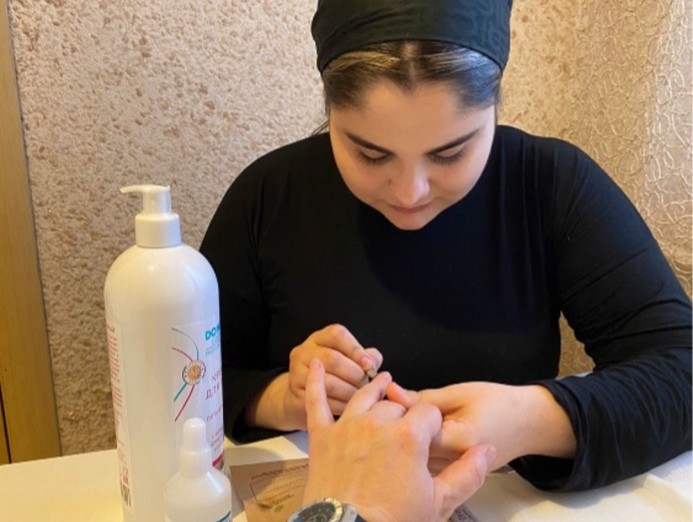
The morning routine begins early for Iman in Grozny, Chechnya. When most teenagers hit snooze on their alarms, 15-year-old Iman is already awake, performing her upper body exercises before logging into her online classes. Confined to a wheelchair due to spinal trauma, Iman has structured her days around what she can control – her education, her determination, and now, her flourishing career as a nail artist.
“The main challenge I face in my daily life is the inability to walk and be self-reliant in the simplest activities that other people can afford without any efforts,” Iman says. “I am greatly obliged to my parents for their patience and love.”
Yet this young woman from Chechnya is rewriting what independence looks like.
A turning point
A friend had shared information about Islamic Relief’s free vocational training programme for people with disabilities through WhatsApp, Iman saw the opportunity and never looked back.
For a family where the sole breadwinner is Iman’s 21-year-old brother Muslim (who works in airport security) and where medical expenses for Iman’s regular rehabilitation courses and operations constantly strain resources, this felt almost destined.
“I like it very much to draw, that’s why we decided that I should take manicure classes,” Iman explains. Her mother Razet called Islamic Relief for details, and soon they were invited to the first lesson. “It was great!” Iman recalls.

From student to business owner
What Islamic Relief provided went beyond the expected. Iman didn’t just acquire manicure and pedicure skills – she received all the equipment and materials needed to open her own studio. Income from Muslim’s salary, Iman’s disability pension, and her mother’s small carer’s allowance are often not enough to cover monthly costs, this support from Islamic Relief helped transform possibility into reality.
“It is a great thing to be able to work and earn something yourself!” Iman says with pride.
The work demands excellence. Building a client base requires not just technical skill but trust, reliability, and the ability to deliver results that keep customers coming back. For someone who must navigate daily life from a wheelchair, each client appointment represents a small victory – over societal assumptions, over logistical challenges, over the limitations others might impose.
Iman’s first income – 6,900 roubles (approximately RM415) – represents far more than its monetary value. It’s proof of capability, evidence of independence, and validation that her worth isn’t defined by her disability.
The power of belief
“Our teacher is a great person, she inspired us so much and welcomed all our efforts,” Iman remembers. “This made us sure we would succeed”
This belief – from her instructor, from her family and supported by Islamic Relief – has been transformative. In a world where people with disabilities face unemployment rates as high as 80% in some countries and assumptions about capability often precede any assessment of actual ability, Iman’s story challenges every limiting narrative.
She studies online in Year 9, managing her education despite regular interruptions for medical treatment. She maintains morning exercise routines. She builds a business. She does all of this whilst relying entirely on others for basic mobility.
“I saw many people who cannot use their legs, but they use their brain and hands to be useful to the society,” Iman reflects.
Building community, not just business
For Iman, the vocational training programme delivered unexpected gifts alongside the practical skills. “I have gained skills and met many good friends! I have received a lot of good memories!” she says.
This social dimension matters profoundly.
“I don’t like it to be alone, I like people and communication,” Iman explains.
The programme created what all good disability inclusion initiatives should: not a separate space for people with disabilities, but an environment where they could learn, grow, and build community together whilst developing skills.
Looking forward with hope
“Insha’Allah, I will continue to work as a nail master, since I like it very much,” Iman says of her future. Her aspirations are to continue doing the work she loves and to maintain the independence she’s worked so hard to build.
She’s practical about improvements too, suggesting that training facilities could benefit from more spacious rooms and stationary ramp entrances – the kind of accessibility features that demonstrate genuine commitment to inclusion.
Her message to Islamic Relief carries the gratitude of someone who understands exactly what was given: not charity, but opportunity. “I would like to thank people in the Islamic Relief who thought of this kind of project. Such attitude gives people with disabilities a chance to become more skilled and make their dreams come true!”
What real support looks like
As the world marks International Day of Persons with Disabilities, Iman’s story reminds us that leadership comes in many forms.
Sometimes it looks like a 15-year-old girl in Grozny, building a business from a wheelchair, proving that determination and opportunity can overcome obstacles that once seemed insurmountable.
Her hands may create beautiful nails, but her story paints an even more beautiful picture – of resilience, of family support, of organisational commitment, and of a young woman refusing to let disability define the boundaries of her life.
This International Day of Persons with Disabilities, Islamic Relief Worldwide celebrates individuals like Iman who lead through their courage, determination, and refusal to accept limitations. Their leadership lights the path towards a truly inclusive and sustainable future for all. Support our work and help us provide opportunities for more people like Iman, donate today.